“There are countless names that echo in the chambers of memory – names that were celebrated – even feared, during the halcyon days of Kofifi Sophiatown … Father Trevor Huddleston, Dolly Rathebe, Duba Duba, Bloke Modisane and a colourful array of others. Then, there’s Hugh Masekela … ” – Don Mattera’s Foreword.
Excerpt From: Hugh Masikela. “Still Grazing”. Apple Books.
In reading this excerpt and the book at large, you will most certainly realise that all the names of the mentioned ‘greats’ formed part of the cultural, social and historical milieux that Bra Hugh was part of. Most certainly, you will appreciate the great role that Father Huddleston played in Hughie’s live and the lives of his contemporaries including that of Ntate Musa Jonas Gwangwa.
I choose to celebrate Hugh Masekela by continuing to listen to his music and his interviews. On both mediums he shared his views, experiences, and mostly importantly his elaborate wisdow and wit. I choose to celebrate Bra Hugh – a name that we all affectionately called him with and that remains part of our collective memory here in South Africa – through his work of art. One important work of art that he gifted us with – that many do not speak much about is his memoir titled: Still Grazing: The musical journey of Hugh Masekela that he beautifully co-written with Michael Cheers, an Associate Professor of Journalism at the School of Journalism and Mass Communications in the United States of America (USA).
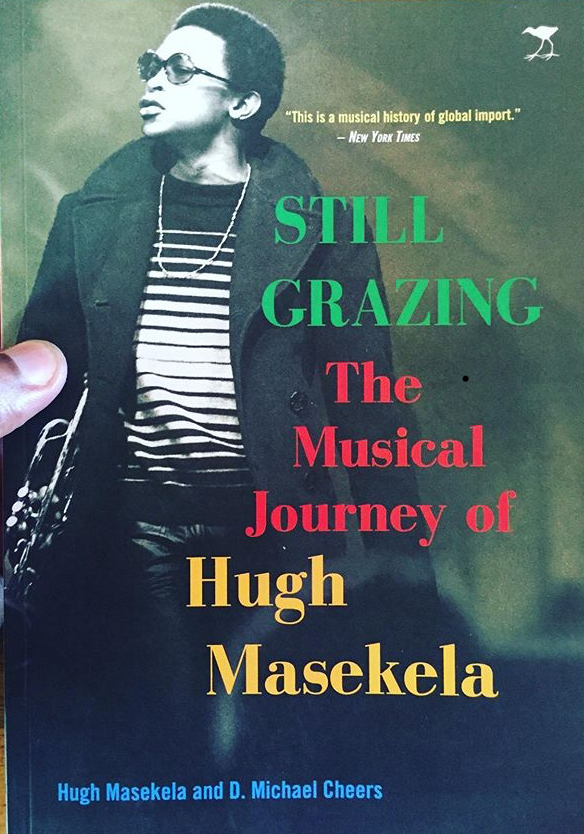
I recently finished reading Bra Hugh’s book and I must say it was a heart-warming read. I got to learn the good, bad and the ugly of Bra Hugh’s life. This book made me appreciate him holistically as cliched that may sound to some.
Without a doubt, this book will teach you a thing or two about the power of believing in yourself, about taking that leap of faith and following your passion. Hughie was willing to leave his family to follow his passion, that of being a Jazz Artist, a trumpeter to be precise. Today, he remains one of the most celebrated jazz artists to hail from the foreshores of Southern Africa. The young man was born KwaGuqa, Witbank (eMalahleni) in Mpumalanga. One can get to learn more on his biography from the book itself. Here, I choose to celebrate Hughie quite differently please allow me to celebrating him in the following way:
Bra Hugh lived his life to the fullest and was brave enough to chronicle this down in his memoir. When reading the book, you will be exposed to the demons he faced in his life. He also chronicles his demise that was caused by his addiction, not only to drugs but to alcohol and sex. In fact, the book is so brutally honest such that it leaves you questioning yourself, if you would ever be able to triumph against the demons that Hughie was able to overcome in his life?
This is a book I would recommend to any potential artist(s) out there, and to readers themselves, for them to learn from one of the greatest artists of Azania about the dangers of drug addiction. Artists in general are at high risk of mismanaging their finances and being addicts because of the nature of the industry they are members of. Hence I believe, reading this book can shed some light into your life in one way or the other.
As Dr. Don Mattera points out in the foreword, Bra Hugh is an icon that we cannot afford to ignore. It would be malicious of us to do so if you ask me. I therefore choose to celebrate him in song and the written word.
As Dr. Don Mattera points out in the foreword, Bra Hugh is an icon that we cannot afford to ignore. It would be malicious of us to do so if you ask me. I therefore choose to celebrate him in song and the written word. One particular song that I think resonates very well with his book is not just Still Grazing but The boy’s doin’it. He really did it – the whole world is fond of his music and his legacy at large.
In this version of the song, you cannot help but trace the influence that Fela Kuti had in this sound of music that he was grappling with at the time. In the book too, he speaks about the beauty of meeting Fela Kuti whom he endeared, dearly. I really enjoyed reading that part because during that time, Bra Hugh was searching for home. This moment in his life led to the birth of one of his greatest albums in my view called: Home is where music is. At the time, Hughie underwent a pilgrimage by traveling to Africa as he could not travel back to the country, at some point he was denied the opportunity to bury some of his loved ones just like most exiles that were prohibited from entering South Africa at the time. It was then that Hughie met Fela Kuti and him meeting Fela formed part of the ‘completion’ of his journey and pilgrimage. But, Bra Hugh admits in some interviews that he struggled for years, more 30 years, to perfect the Afrobeat / highlife sound that he wanted to infuse in his music, of course having been inspired by Fela Kuti himself and undoubtably his music.
Now, when listening to Bra Hugh’s latest collaboration that he did with Tony Allen – a project that they did a few years ago but only released this year, posthumously Bra Hugh’s lifetime, becomes a full-circle moment in terms of him perfecting the Afrobeat sound. Moreover, listening to this project called Rejoice is an act of celebrating Bra Hugh and Tony Allen who has recently passed on. I am sure wherever they are they are probably rejoicing. It is therefore worth reading this article below:
https://pitchfork.com/reviews/albums/tony-allen-hugh-masekela-rejoice/
In closing, I choose to celebrate Bra Hugh by cherishing his values of cultural restoration and heritage preservation. In doing so, let us continue to celebrate Ntate Ramapolo Hugh Masekela, the son of Polina Bowers and Thomas Selema Masekela. A grandson of Johanna Mthise Mabena-Bowers and Mamoshaba and Hopane Masekela.
Ka nnete go iketsi ke go phela. (Indeed knowing thyself is to live).
Dilo makwati, di tsewa mo go ba bangwe*.
Inyathi ibuzwa kwabaphambili*
– we learn from those who have walked the path before us.
(**NB: these are not direct translations and the two phrases meaning one of the same thing)
 Khayelethu Reading Club