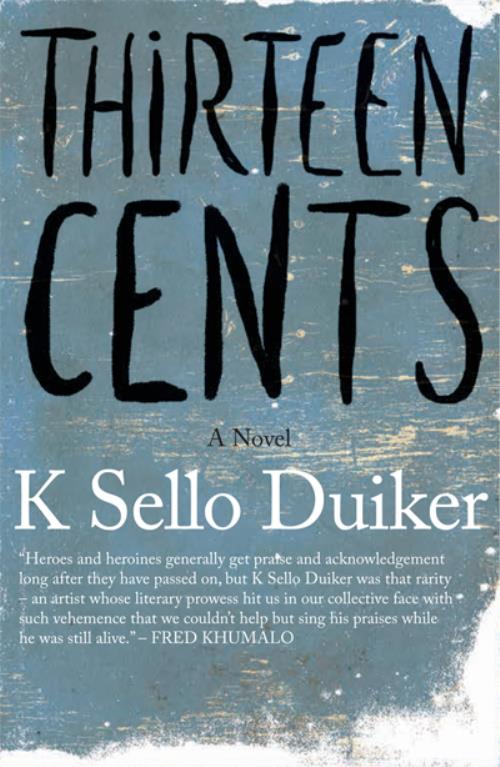
This is a riveting and captivating novel written by one of South Africa’s most prolific writers, Sello Kabelo Duiker. This novel is his debut which was awarded the 2001 Common-wealth Writer’s Prize for Best First Book, Africa Region.

The novel is written in first person narration from the perspective of the twelve year-old boy child, Azure (or Ah-zoo-ray as he insists to be referred to) who is the protagonist. The use of first person narration and present tense as a literary device functions as a tool to explore the innocence of childhood, and to highlight the element of immediacy in the unfolding story. What is meant in the latter is that, the element of immediacy is used to reveal how the story happens as it is told as opposed to being told through a form recollections or back-and-forth accounts of reflection which a writer like Arundhati Roy employs in her award-winning novel, The god of small things, but that is a topic for another day.
The story revolves around Azure’s life as a street kid living in the larny streets of Sea Point, Cape Town. The story reveals the harsh conditions that this young man had to deal with following the passing of his parents who lived in Mshenguville – a fictional township somewhere in Johannesburg. He lives as a homeless orphan in place where he knows no one, where he is left to fend for himself and has to find ways to survive the harsh realities of homelessness – which vary from violence, gangsterism, crime, rape, prostitution and having to deal with corrupt police officers among other things. He is basically confronted with the underworld of Cape Town.
Azure is a school drop-out and we get to learn about this right at the beginning of the story, where he brutally tells us that the last time he went to school was three years ago only to find his parents “in a pool of blood” in their shack when he came back from school. This is quite a traumatically gripping image for a thirteen year-old child. Already this incident sets the tone of the kind of traumatic violence that ‘Blue’ experiences in the novel. The name Blue is one that Azure was given because he had blue eyes, he was given this name by one of the notorious gang members of the 28s, Gerald, a man who terrorises the town and is feared by many. One cannot help but hate the kind of person Gerald was, even though a few admired him because of the power he possessed as a gangster – he had money, fancy clothes and drove a white Ford Grenanda. His supposed power does not put him on a pedastal, at least not me as a reader of this novel. I loathe the person Gerald was and this is something I want to believe that one personally shared with Azure himself, and fortunately, the novel shows us consistently that Azure hated the man. But that is shown implicitly rather than explicitly, I think.
Another interesting character is that of Bafana, a 9-year old street kid that lives with Azure in Sea Point. He is such a naive young man from Langa and his friend Azure was puzzled as to why Bafana preferred being homeless despite the fact that he still had a home back in Langa with both parents that he could always returned to at any given point in time. The relationship between these two is interesting in the sense that Azure viewed himself as Bafana’s senior given the age gap between them, and he would often remind him, whenever he saw fit, that Bafana is a “laatie” to him, a “moegoe”, that he was not as street-wise like he was. So, the two would often argue about the most trivial things. Weirdly though, Bafana was a drug addict, he smoked glue and button which would often make him behave bizarrely. Azure on the other hand despised these drugs, he only enjoyed his zol (dagga that is) and the irony here, is that you would expect Azure to be the one that takes and enjoys these hard-core drugs. In fact, Azure did not even enjoy drinking alcohol.
It is the relationship of these two boys that is at the centre of the story, at least in the first part of the book. In this section, one is drawn more towards the innocency of these two young boys living in the streets of Sea Point and Camp’s Bay. They do the most discomforting things to survive – to get food and make a living for themselves. Azure in particular dabbles in prostitution as his way of surviving, and for him to make ends meet. He often sleeps with white men (sometimes married men) who then pay him for either playing with their genitals, or engaging in penetrative and oral sex with them in exchange of money and sometimes food. It is at this juncture that the theme of prostitution, sexuality and identity is foregrounded, and in the process Azure tries to establish who he really is. The sex scenes are very explicit and can be terribly discomforting considering Azure’s age. But in my view, Sello compels his readers to be emphatic to this young man by forcing them to make sense of circumstances Azure found himself in rather than them placing any form of judgement against this young man, whose world had crumpled before his eyes. The young lad had his back on his wall and was expected to face the world with grace despite the harsh realities he was confronted with.
Nevertheless, the other themes explored in the novel include: substance abuse, the bad vs good, angels vs devils. And it is particularly the second part of the novel that tackles these themes with the deliberate use of symbolism and magical realism (if you will) as tools of revealing these contradictions. I mention this because at the climax of the unfolding story – where Azure gets beaten by Sealy (one of his trusted friends) having been instructed by Gerald to “fucking him up”, Azure stands up to face his fears by actually confronting Gerald and stands up for himself as he was advised by Vincent. Azure after being kidnapped, tortured, and then molested by Gerald’s cronies, begins this journey of self-discovery. During this journey, Gerald first reveals to Azure certain discomforting details about Azure’s parents and how they died. Then he gives him life lessons that he should use to survive the streets: that he should be unapologetic and confident. Upon hearing these details, a sceptic Azure undergoes a self-discovering journey and runs away from the City where he ends up finding refuge in Table Mountain.
While he is in Table Mountain, Azure encounters the supernatural world and interacts with these demigod figures, that help him develop his inner strength – a strength that he ends up using to fight the demons he was faced with. At this juncture, the book taps into the supernatural world wherein it becomes difficult to distinguish what happens in the real world versus what happens in the imagined supernatural world. Fortunately enough, one gets to learn that the supernatural world only occurs when Azure is dreaming. His sleep takes him to this unknown world. But at the same time, there are instances in the first section of the book whereby pigeons and seagulls symbolise some demigod characteristics as we get to learn about some of the supernatural powers Gerald had – he had eyes and ears everywhere in the City (in the form of pigeons), which Gerald would often instruct them to follow Azure around, especially when he was on the run – running for his life as Gerald wanted to kill him. These pigeons operated as Gerard’s watchdogs – his surveillance basically.
This particular literary device complicates the book in a way, because one ends up being left with the impression that the book is partly a speculative fiction (as it delves into the supernatural world with interesting use of symbolism and magical realism); and partly a bildungsroman given that the novel is about the coming of age of Azure. Towards the end of the book, it is made quite clear that Azure now views himself as a “man” and I suppose, his justification is the amount of experiences he has experienced, not many children of his age can actually relate to what he has been through and that is what qualifies him to be the man that he perceives himself to be. With that said, one holds the view that somehow this book bends the categories of genre because in a way the book shares a duality – the book can be said to belong into both genres of speculative fiction just as it belongs to the genre of bildungsroman. This duality was carefully crafted in the novel and the author must be commended for his artistic brilliance.
Lastly, I personally enjoyed this book because of the simplicity of the language used and the rich, layered nuances I picked up in the book. The book is absolutely an intriguing read not only because it delicately deals with the underworld of Cape Town (which is still very much intact till this day, by the way) but also because of the way moments of vulnerability, in the book, were approached with the level of sensitivity that they deserved. For a debut novel, Sello outdone himself here.
*Side note: The author has also written two other novels: The quiet violence of dreams and The hidden star (respectfully). Do check them as well. Hopefully, I will review them later this year.


 Khayelethu Reading Club