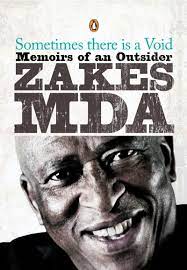
This is the very question I asked myself before I actually started reading this novel because I was more intrigued about the reason(s) why Prof. Zakes Mda would write about Madonna. Well, I had to read the book to find the answer(s) – if any existed. With that in mind, in this review, my focus is in the different ways in which madonna is represented as multiple as they were: symbolically and otherwise.
So, without further ado, here is my attempt in unpacking these various forms of representation of Madonna. The long and short answer is that it is still unclear to me as to why the author chose to title the representation of the women he wrote about in the book as ‘Madonna’, but I will nonetheless attempt to language the possible reasons why he did in the way he did, at least from the way I see it. Also, is must be pointed out that the aim here is not necessarily to reduce the entire novel to this representation of the women spoken about in the novel as the Madonna – whatever that means, but rather to think creatively and critically about what the book achieves in representing the women characters in the book in the various ways it did.
The novel, The Madonna of Excelsior is Zakes Mda’s third novel written in the year 2002. It is a novel that is based on a true-life event(s) in the town of Excelsior, Bloemfontein, whereby in 1971, a group of Afrikaner men were arrested for breaching the Immorality Act and were involved in what is described as “miscegenation” in the novel (as one of the chapters deals with this topic at length). The novel revolves around the lives of Niki and her children, Viliki and Popi whose life struggle is nothing but that of survival, given that their mother Niki worked as a domestic worker and a single parent.
Viliki’s father, Pule, on the other hand, was a deadbeat father and because of that, Niki had to find ways to make ends meet. She then decided to become a model for a local painter, Father Frans Claerhout – they sometimes referred to him as ‘Father’ or ‘the trinity’ because he was after all, a priest, an artist and a man hence he was interested and “an admirer of big hands and big breasts” (p. 2). His subjects were always women, the madonnas as we come to learn. Niki would therefore model for the trinity in order to feed her children. Niki like the other women in the novel – the other madonnas, would frequent to Thaba Nchu, where the priest was located, at the Roman Catholic mission in order to model for him whenever he was in the mood to paint his madonna subject(s). This is to say, Niki at some point was also a madonna that the priest was interested in painting. She too stripped naked for the priest for him to paint his Madonna subject into his canvass. This is to say, in the novel madonna were the women who were objects to the white men whose gaze tortured them not only at level of being the subject of the composition of visual art (The Trinity was much guilty of this), but also at the level of being victims of rape, assault and abuse (the other Afrikaner men are guilty of this), as I am going to demonstrate further in the review. I think it is noteworthy to make the disclaimer that I do not name these other Afrikaner men deliberately in this review, not as a way to appease their sensibilities, but rather to reduce their symbolic sense importance hence not mentioning their names does not fascinates me, my interest is not on them, but rather on the madonnas. Yet, this is not to suggest that their roles in the novel is insignificant, but rather my not mentioning their names should be seen and appreciated as a way of dignifying the women they violated.
So, moving to the prose, the words from the opening line of the novel are quite strikingly poignant and invigorating, they leave the reader curious, to say the least, in as far as forcing the reader to question: which sins are these that are alluded to in the opening line? Simply because the opening line reads as follows: “All these things flow from the sins of our mothers”, this opening line forces oneself to helplessly wonder what kinds of sins could these be? I personally could not help myself but wonder about these sins.
Essentially, the main plot is centred around the idea of miscegenation and in a way, the children who were birthed as a result of the sexual relations (between the Afrikaner men and the black women from Excelsior – the madonnas) become the bearers of the shame and guilt of their mothers’ sins but at the same time, the book approaches the notion of blame between the victims (the women who were at times forcefully lured to sleep with Afrikaner men) and the perpetrators (the Afrikaner men) in a back-and-forth kind of approach – where the victims blame the perpetrators, and the perpetrators blame the victims. Thus, a pendulum swings on both sides, but in the end, it is left to the reader to decide which side was innocent and which side was not.
Ultimately, the apartheid regime favoured Afrikaner men and this came as no surprise, but as something that should have been expected from a vile system whose mandate was, at all material times, maintain racial segregation and discrimination. Thus, in the novel we are challenged to battle with is dichotomy of blame-guilt situation between the victims and the perpetrators, this unfolds particularly during the court proceedings where the white men end up being acquitted. Later, the black women too are let free but only on bail with conditions – that in and of itself speaks symbolically to the systemic racism and victimisation of black bodies, particular black women, the madonnas that they were subject as a result of systematic racism.
Nevertheless, elsewhere, it is argued that Zakes Mda utilised satire as a literary device to further complicate the conflicting and contradicting relations between the black and white people in this book (see Ralph Goodman, 2009)[i]. For example, when looking at the character of Sekatle, “the rich business man” who is a politician in his own right, we get to notice how Mda satirised his character by pointing out the contradictions he symbolised given that he always claimed to be for the people as a the member of “the Movement” (the ANC in case you are wondering), yet in defending the people of Bapeihi, he tried to benefit from their plight when they were in need of housing. In this instance, Sekatle is satirised to expose his political manipulation and exploitation as he used his political power for his own personal gains.
As pointed out by Goodman (2009, p. 302), in the novel, “Mda focuses on Sekatle, using the disjunction between the intentions and the discourse of this former lackey of the apartheid system to satirise him”. The point here is that Sekatle is satirised as a hypocritical individual whose behaviour symbolises the thuggery behaviour of corrupt politicians who have no interests in serving the people, instead focus on their self-enriching endeavours. Thus, the satire functions in the effect of making this subtle observation about corrupt politicians even in the wake of the democratic dispensation. The novel at this point also morphs itself into being a microcosm of what was happening in South Africa at the time just after the democratic dispensation. In fact, it would not be a misreading of the novel to suggest that this particular issue (of corruption) raised in the novel is relevant till today, because our leaders are rotten to the core just like Sekatle.
Furthermore, the novel can also be read as a critique of the then democratic state, the ANC government who already in the early years of 2000s showed signs of corruption, greed and lack of morale as the leaders of the state. Perhaps, in this is instance Mda’s the novel can be read as a political commentary, especially considering the the latter part(s) of book where the period of democracy is tackled. I am making this argument with the utmost humility because I believe that Mda by borrowed from what Nina Simone speaks about in her meditation the role of the artists (in this case the novelist): “to reflect the times” . I believe that Mda’s novel functions as political commentary at that level, to critique the style of leadership that some of the country’s politicians like Sekatle from the novel showcased, by being greedy, deceitful and conjuring for their own personal gains. But then again, that is my own subjective intervention if you will.
But coming back, to the idea of the beauty of the novel, one cannot help but to comment on the narration of the novel, particularly as it relates to how beautifully Mda began each of his chapters by having his characters being foregrounded as the subject matter of the painter, “The Trinity” (whom I have spoken about earlier) and the symbolism behind this deliberate exploration is that each painting provides a hint of what is to follow within the unfolding story in each chapter, this will be demonstrated later in terms of how it formulated in the novel itself.
Among the themes explored in the novel, the theme of racism and racial segration takes centre within the main plot of the novel not only because of the breach of the Immoral Act, but also at the level spatial planning that is commented upon in the novel. The novel is after all set during the apartheid era and moves more towards the 1994 moment and most impostantly, post the ’94 moment – thereby spanning around a period of thirty years. As a result, the whites lived in the suburbs, whilst black people worked as domestic workers for baas, lived in the squalor (Niki and her children lived at the Mahlaswetsa township) and were subjected to abject poverty.
Another theme that is dealt within the novel is that of sibling rivalry – although Popi and her brother got very much along with and cared for each other as siblings, they also had moments of fighting among one another just like most of us who are siblings. The theme of family, motherhood and importantly the aesthetics of visual arts, or the polemic thereof are also the other themes that can be noted in the novel.
The latter also functioned as the leitmotif within the novel, thus the madonna subject takes various formulations because of this intriguing exploration, and is part of the reason why Popi later developed her keen interest in the arts. Her discovery of this new passion of hers arguably forms part of her coming out of age, along with her other ambitions – becoming a political leader in her own right, a path that she followed owing up to her older brother, Viliki whom in his early life was a militant freedom fighter. He too was later elected a the counsellor in the town of Excelsior, something that was unheard of given the racist history of the town itself.
However, the most intriguing theme for me was that of silence – long after her rampant acts of rage against not only the oppressive apartheid regime, but also against the racist judicial system, against the Afrikaner man she once worked and had an affair with, and the one that violated her (later bearing him child, Popi), Niki later faced an existential crisis where her rage became a silent one, that of regret and resentment. She no longer had it in her to fight, fortunately or unfortunately, that became a battle that her children adopted, wittingly or unwittingly, but for different reasons. Theirs was to wage struggle against apartheid. Ultimately, political freedom was achieved, but it came with its own challenges.
Nevertheless, Niki resented the man that violated her, she resented the white man she worked for and the wife of that same man who was jealous of her beauty. She also resented the man that she had assumed would be the lover of her life, Pule. This was the very man that betrayed her by leaving her for cheaper women at the mines, in the city where he worked, leaving her to fend for herself and having to raise her kids all by herself. This particular theme is what brings so much anger to me as a reader because it demonstrates effectively how the apartheid system deliberately broke down the family life and structure of black people, not out of their own willingness, but as a result of their subjugation and conscription to the migrant labour system.
At times, the writing read like a poem and this was one thing that one could not take for granted within the novel. For instance, the descriptions at the beginning of each chapter were so refreshing to read. The descriptions at the beginning of each chapter in the novel painted a particular picture of what would follow, and creatively, these descriptions in one way or the other became in synch with the mood of each chapter.
For example, in the book one of the chapters reads with this opening line:
“Colour explodes. Green, yellow, red and blue. Sleepy-eyed women are walking among sunflowers. Naked women are chasing white doves among sunflowers. True atonement of rhythm and line. A boy is riding a donkey backwards among sunflowers. The ground is red. The sky is blue. The boy is red.”
This chapter is the one that helped us to get to know about the secrets of the madonnas of Excelsior, as they would engage in dubious activities of entertaining Afrikaner men despite knowing that such an act was against the law. The striking thing here was that the painting of these madonnas being in the “green, yellow and red” colours “walking among sunflowers” (in the veld I would assume) created a possibility where these women made love to these men, hence the imagery of the beautiful ambiance that is described above. But, at the same time, the same imagery as the story unfolds took a sharp curve where now the very same Afrikaner men chose to violate these beautiful black women, including Niki by means of raping them. The imagery is now collapsed into an unsettling one.
In closing, the question I opened with was Who is Madonna? I hope this review helped in trying to find out who is this madonna is and why was she (or they) have been represented in the various ways they have been represented in the novel.
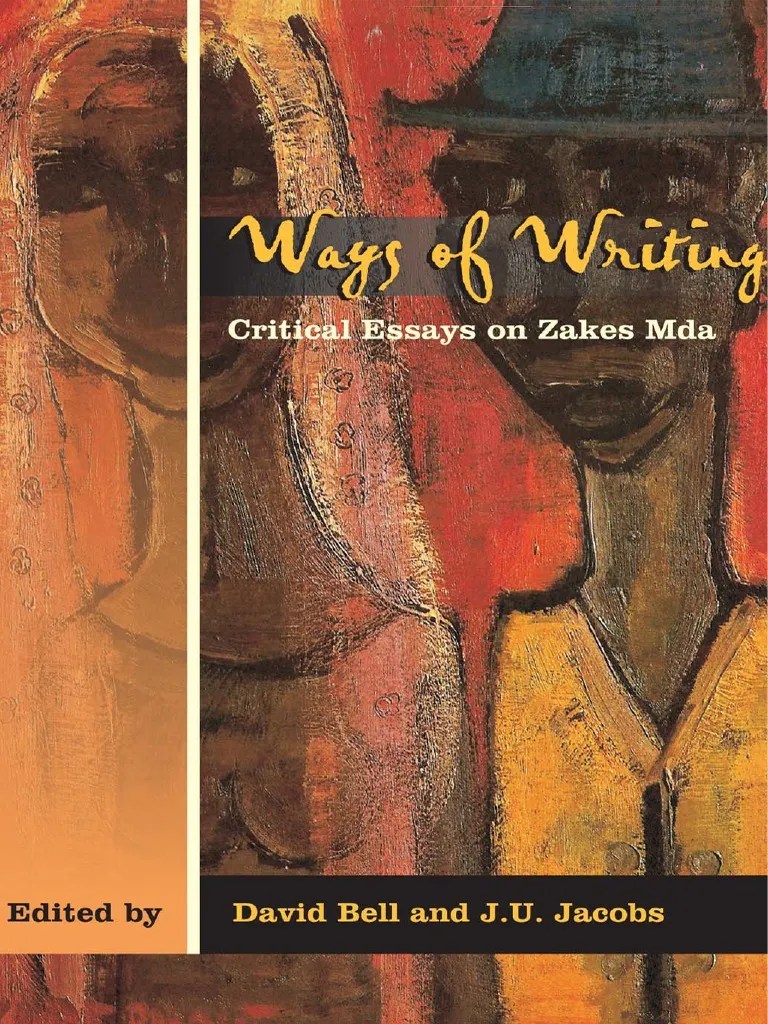
[i] Goodman, R. (2009). Race and post-colonial issues in The Madonna of Excelsior. In D. Bell & J. U. Jacobs (Eds.). The ways of writing: Critical essays on Zakes Mda (pp. 299-.313).Durban, South Africa: UKZN University Press.
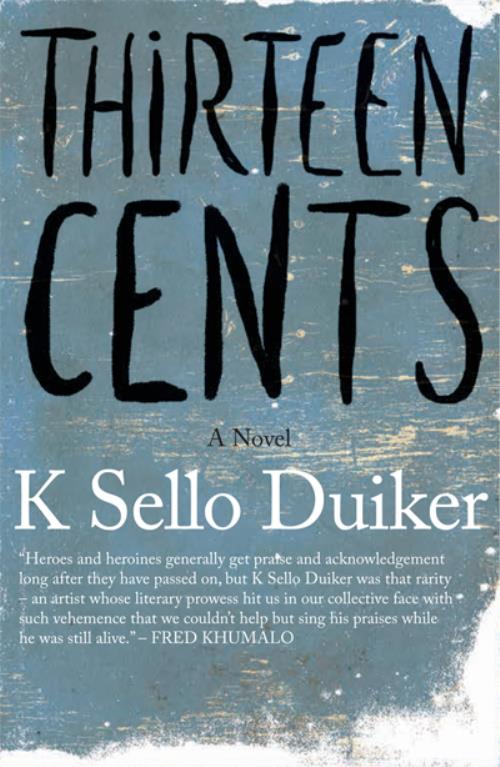
This is a riveting and captivating novel written by one of South Africa’s most prolific writers, Sello Kabelo Duiker. This novel is his debut which was awarded the 2001 Common-wealth Writer’s Prize for Best First Book, Africa Region.
The novel is written in first person narration from the perspective of the twelve year-old boy child, Azure (or Ah-zoo-ray as he insists to be referred to) who is the protagonist. The use of first person narration and present tense as a literary device functions as a tool to explore the innocence of childhood, and to highlight the element of immediacy in the unfolding story. What is meant in the latter is that, the element of immediacy is used to reveal how the story happens as it is told as opposed to being told through a form recollections or back-and-forth accounts of reflection which a writer like Arundhati Roy employs in her award-winning novel, The god of small things, but that is a topic for another day.
The story revolves around Azure’s life as a street kid living in the larny streets of Sea Point, Cape Town. The story reveals the harsh conditions that this young man had to deal with following the passing of his parents who lived in Mshenguville – a fictional township somewhere in Johannesburg. He lives as a homeless orphan in place where he knows no one, where he is left to fend for himself and has to find ways to survive the harsh realities of homelessness – which vary from violence, gangsterism, crime, rape, prostitution and having to deal with corrupt police officers among other things. He is basically confronted with the underworld of Cape Town.
Azure is a school drop-out and we get to learn about this right at the beginning of the story, where he brutally tells us that the last time he went to school was three years ago only to find his parents “in a pool of blood” in their shack when he came back from school. This is quite a traumatically gripping image for a thirteen year-old child. Already this incident sets the tone of the kind of traumatic violence that ‘Blue’ experiences in the novel. The name Blue is one that Azure was given because he had blue eyes, he was given this name by one of the notorious gang members of the 28s, Gerald, a man who terrorises the town and is feared by many. One cannot help but hate the kind of person Gerald was, even though a few admired him because of the power he possessed as a gangster – he had money, fancy clothes and drove a white Ford Grenanda. His supposed power does not put him on a pedastal, at least not me as a reader of this novel. I loathe the person Gerald was and this is something I want to believe that one personally shared with Azure himself, and fortunately, the novel shows us consistently that Azure hated the man. But that is shown implicitly rather than explicitly, I think.
Another interesting character is that of Bafana, a 9-year old street kid that lives with Azure in Sea Point. He is such a naive young man from Langa and his friend Azure was puzzled as to why Bafana preferred being homeless despite the fact that he still had a home back in Langa with both parents that he could always returned to at any given point in time. The relationship between these two is interesting in the sense that Azure viewed himself as Bafana’s senior given the age gap between them, and he would often remind him, whenever he saw fit, that Bafana is a “laatie” to him, a “moegoe”, that he was not as street-wise like he was. So, the two would often argue about the most trivial things. Weirdly though, Bafana was a drug addict, he smoked glue and button which would often make him behave bizarrely. Azure on the other hand despised these drugs, he only enjoyed his zol (dagga that is) and the irony here, is that you would expect Azure to be the one that takes and enjoys these hard-core drugs. In fact, Azure did not even enjoy drinking alcohol.
It is the relationship of these two boys that is at the centre of the story, at least in the first part of the book. In this section, one is drawn more towards the innocency of these two young boys living in the streets of Sea Point and Camp’s Bay. They do the most discomforting things to survive – to get food and make a living for themselves. Azure in particular dabbles in prostitution as his way of surviving, and for him to make ends meet. He often sleeps with white men (sometimes married men) who then pay him for either playing with their genitals, or engaging in penetrative and oral sex with them in exchange of money and sometimes food. It is at this juncture that the theme of prostitution, sexuality and identity is foregrounded, and in the process Azure tries to establish who he really is. The sex scenes are very explicit and can be terribly discomforting considering Azure’s age. But in my view, Sello compels his readers to be emphatic to this young man by forcing them to make sense of circumstances Azure found himself in rather than them placing any form of judgement against this young man, whose world had crumpled before his eyes. The young lad had his back on his wall and was expected to face the world with grace despite the harsh realities he was confronted with.
Nevertheless, the other themes explored in the novel include: substance abuse, the bad vs good, angels vs devils. And it is particularly the second part of the novel that tackles these themes with the deliberate use of symbolism and magical realism (if you will) as tools of revealing these contradictions. I mention this because at the climax of the unfolding story – where Azure gets beaten by Sealy (one of his trusted friends) having been instructed by Gerald to “fucking him up”, Azure stands up to face his fears by actually confronting Gerald and stands up for himself as he was advised by Vincent. Azure after being kidnapped, tortured, and then molested by Gerald’s cronies, begins this journey of self-discovery. During this journey, Gerald first reveals to Azure certain discomforting details about Azure’s parents and how they died. Then he gives him life lessons that he should use to survive the streets: that he should be unapologetic and confident. Upon hearing these details, a sceptic Azure undergoes a self-discovering journey and runs away from the City where he ends up finding refuge in Table Mountain.
While he is in Table Mountain, Azure encounters the supernatural world and interacts with these demigod figures, that help him develop his inner strength – a strength that he ends up using to fight the demons he was faced with. At this juncture, the book taps into the supernatural world wherein it becomes difficult to distinguish what happens in the real world versus what happens in the imagined supernatural world. Fortunately enough, one gets to learn that the supernatural world only occurs when Azure is dreaming. His sleep takes him to this unknown world. But at the same time, there are instances in the first section of the book whereby pigeons and seagulls symbolise some demigod characteristics as we get to learn about some of the supernatural powers Gerald had – he had eyes and ears everywhere in the City (in the form of pigeons), which Gerald would often instruct them to follow Azure around, especially when he was on the run – running for his life as Gerald wanted to kill him. These pigeons operated as Gerard’s watchdogs – his surveillance basically.
This particular literary device complicates the book in a way, because one ends up being left with the impression that the book is partly a speculative fiction (as it delves into the supernatural world with interesting use of symbolism and magical realism); and partly a bildungsroman given that the novel is about the coming of age of Azure. Towards the end of the book, it is made quite clear that Azure now views himself as a “man” and I suppose, his justification is the amount of experiences he has experienced, not many children of his age can actually relate to what he has been through and that is what qualifies him to be the man that he perceives himself to be. With that said, one holds the view that somehow this book bends the categories of genre because in a way the book shares a duality – the book can be said to belong into both genres of speculative fiction just as it belongs to the genre of bildungsroman. This duality was carefully crafted in the novel and the author must be commended for his artistic brilliance.
Lastly, I personally enjoyed this book because of the simplicity of the language used and the rich, layered nuances I picked up in the book. The book is absolutely an intriguing read not only because it delicately deals with the underworld of Cape Town (which is still very much intact till this day, by the way) but also because of the way moments of vulnerability, in the book, were approached with the level of sensitivity that they deserved. For a debut novel, Sello outdone himself here.
*Side note: The author has also written two other novels: The quiet violence of dreams and The hidden star (respectfully). Do check them as well. Hopefully, I will review them later this year.
This is the debut novel of the Nigerian-born poet and novelist, Lola Shoneyin. It is an intriguing novel which is based on the complications of polygamy. The novel revolves around the lives of the four wives of Baba Segi (also known as Ishola Alao), a wealthy rich man. These wives are Iya Segi, Iya Tope, Iya Femi and the newly-wed Bolanle, my personal favourite in the novel.
Nigerian poet and author, Lola Shoneyin.
Baba Segi is a typical Big Man as many men like him are often labelled in the Nigerian literary canon. In the novel, he is described as the man of the house who is “plump and prosperous”. His authority is felt quite quickly in the novel through his revered armchair that nobody else gets to use but himself. He does however reward his wives with an armchair after they were able to bear him his children. Weirdly enough, he gained his wealth when the mother of his first wife, Iya Segi, donated money to him so that he could marry his daughter. She did that because she did not want to be an example of a bad parent whose daughter was unable to marry. Basically, Iya Segi’s mother did not want her daughter to become ‘lefitwa’ – a word in Sesotho which describes a woman who has been unable to marry or has had a failed marriage.
It is therefore not surprising that Iya Segi had a lot of entitlement in Baba Segi’s household. Her entitlement was two fold: first, she was the first wife to this polygamous man, so she had all the authority to the be the leader among the other wives. Secondly, she was the main reason that this man enjoyed so much wealth after he inherited all the businesses she owned prior to marrying him.
The novel is set in Ibadan, one of the famous cities in Nigeria, yet it remains a very rural novel as the characters spend time in different villages including Baba Segi’s favourite: Ayikara – a place he would often visit to seek counsel from his friend, Teacher. This is place where he found refuge. He frequented Ayikara when he needed help and advice from other men that went there for the same reason(s): to pour out their hearts about the troubles they had as a result of their “quarrelsome” wives.
As mentioned before, the book tackles the topic of polygamy quite strongly and as the title of the book suggests the three wives married to Baba Segi had a secret that they devoted themselves not to reveal whatever it took. However, it is the presence of the fourth wife, Bolanle – a beautiful educated woman that forces Baba Segi to seek scientific truth around her barrenness. Bolanle’s so-called barrenness is symbolised by Baba Segi’s bellyache – a sign in his mind that indicates the reason why he needed to do ‘something’ about his wive’s inability to birth children for him.
The irony in this book is that the same reason why Baba Segi’s went to seek scientific truth is the same reason he found out about the secret of his other three wives had kept from him. The other wives include Iya Segi, Iya Tope (whom was the most neutral in so far as displaying some humility and genuineness towards Bolanle) and Iya Femi. The first and third wives, Iya Segi and Iya Femi, resented Bolanle so much, they always displayed contempt towards her not only because she was educated – unlike them – but also because she was beautiful and that she happened to be Baba Segi’s favourite. This was evidenced by the many gifts that Baba Segi would buy for Bolanle. Iya Segi and Iya Femi also resented Bolanle with contempt because she was loved by the kids and she was good with them. This is despite the fact that at first some of the kids imitated their parents’s contempt towards her, but it was Iya Tope’s generosity that enabled Bolanle to win the love of Baba Segi’s seven children after she was able to be very friendly with Iya Tope’s children (Tope, Afolake and Motun).
This is a very interesting book that is worth reading and I believe anyone that is interested in Nigerian literature like I am will definitely enjoy this book as I have. Not only is the writing candid, humorous and easy to read, the book also manages to use each character’s voice and perspective quite distinctively such that one gets fascinated by the idea of time in the book. I mention this because the author interestingly enabled each character to relate their lives (or their stories) in interesting ways where at times each character told their story in retrospect. This enabled the book not to necessarily follow a linear progression in terms of the chronology of the narrative. This is to say, because various characters tell their stories in retrospect, the book does not follow a linear progression as far as the chain of events is concerned.
Needless to say, the book dabbles in the themes of patriarchy, polygamy, marriage, religion versus science (especially in the case where Baba Segi’s believes about the use of herbal medicine is tested by Bolanle’s disregard of its use) and feminism. I want to argue that the book is a feminist text because in the end, the author uses Bolanle’s agency as way to collapse patriarchal authority as if it was Baba Segi’s authoritative decision for her to remain in the marriage or not post the revelation of the other wives’ secret. Instead, Bolanle’s agency and bold character puts to bear the fallacy of Baba Segi’s authoritative dominion, therefore collapsing his patriarchal authority.
I will not divulge on this further as I risk to spoil the book.
“True leadership demands complete subjugation of self, absolute integrity, honesty and uprightness of character, courage and fearlessness and above a consuming love for one’s people” – Mangaliso Robert Sobukwe.
INTRODUCTION
The quote above is one of my favourites by Prof because it encapsulates the kind of person he was, metaphorically and philosophically. However, in this piece, I want to focus on the life of Robert Mangaliso Sobukwe as an Pan Africanist leader whose voice has been silenced beyond the grave. I want to argue that the memory of Sobukwe can be read as an antennae of the history of this country, even though there might be any other reasons why one would want to read more about Sobukwe the icon. For me, his story is part of the history of this country. I want to argue, just as others have said before, that the history of the anti-apartheid struggle would be incomplete not only without the history of Mangaliso Robert Sobukwe and the Pan Africanist Congress of Azania (PAC). At the same time, the history of the struggle against apartheid would be incomplete without the history of Bantu Biko, the Black Consciousness Movement and AZAPO.
Over the years it has been argued that no one has ever managed to accurately introduce Sobukwe as a subject-matter, and I am not going to attempt to do that in any shape or form. What I will do however, is to reinvigorate the memory of his legacy, particularly the written form. In other words, I aim to reinvigorate the memory of Sobukwe through the literature that has been written about his life and his legacy. There are several books that focus on the life and times of Sobukwe that have been published in recent history. But I am only going to review three recent books, even though I am aware that there are about four other books that were published before. As one of these four, How man can die better is the most popular book written by his friend and journalist, Benjamin Pogrund.
The recent books include: The making of a Pan Africanist Leader by Thami ka Plaatjie; Lie on your wounds: The prison correspondence of Robert Mangaliso Sobukwe by Derek Hook and Robert Mangaliso Sobukwe: New Reflections a book written Benjamin Pogrund as an editor. In the latter, Benji invites a diverse range of contributors to speak on the lessons they have learnt and can be drawn from Prof (if you do not know, Sobukwe was called ‘Prof’ because many people revered his calibre as a thinker). Generally, the book invites contributors to reflect on the life, ideas and legacy of Robert Sobukwe through essays.
I mention these three books simply because they form part of the new scholarship and interest in the life and times of Mangaliso Sobukwe – which is something unprecedented. This is unprecedented given that the memory of Mangaliso Robert Sobukwe had been silenced intentionally by the apartheid regime and the continues to be silenced by the current administration that we are told is solely responsible for the democracy and freedom we enjoy today.
However, it must be noted that the eminent resurgence of public interest in the life of Sobukwe as a teacher, thinker, Pan Africanist leader and a global icon comes after numerous social movements like the Rhodes Must Fall which specifically insisted on the decolonisation of South African universities and advocated for the dismantling of the entire historical, social, political, and economic setup of this country.
And one of the things that the Rhodes Must Fall Movement were able to achieve was to conscientise the masses in many campuses – including UCT itself – where the action unfolded. It was through the miasmic atmosphere of protest, acts of rebellion, the vigorous debates and discussions that occurred during the occupation of the Bremner Building (which students deliberately referred to as Azania House – to echo the language of Africanists). These acts of rebellion enabled students to be politically aware of the fallacies of our country – with the Marikana massacre that happened in 2012, three years earlier, as the backdrop – to point out the way our government became antithetical to the legacy of the liberation struggle that freedom fighters like Sobukwe served, suffered and sacrificed his life for.
Desirably or undesirably, many students whom were initially unaware of the myths and fallacies of rainbow(ism), democracy and the delusion of 1994, were able to interrogate, complicate and problematise the notion of ‘freedom’ in occupied Azania.
I also want to believe that it was through the presence of the Pan Africanist Student Movement of Azania (PASMA) among other factors at UCT that enabled many students to get to know about the life of Mangaliso Robert Sobukwe, what he stood for and what the organisation he was part of wanted to achieve.
Perhaps, the call to decolonise the university’s institutional symbols, cultures, names of buildings and the curriculum was not too far from the call for the decolonisation of the history of this country. It was indeed not surprising that, at times, the students at UCT, UWC, Wits and elsewhere found inspiration in Sobukwe, Biko and Fanon because invariably these thinkers were in a conversation, in various ways, with one another concerning the struggle of Africans from across the globe in the fight against European imperialism and colonisation. Their work provided a theoretical framework that students used as modus operandi for their actions during both the Rhodes Must Fall and Fees Must Fall protests.
It is therefore in this context, that I attempt to reinvigorate the memory of Sobukwe, so that future generations may also find inspiration from reading these books featured in this piece.
With that in mind, I want to alert readers that the following reviews are nothing but snippets of the three recent books that have been written about Prof. This piece seeks to encourage readers to read more material on the life and times of Sobukwe who later became a renowned lawyer and community builder in Galeshewe, a township in Kimberly that Prof embraced as his ‘last home’ in Azania as he was subjected to a stringent house arrest by the apartheid regime.
Brief thought’s on Thami ka Plaatjie’s book:
“His intellectual fortitude was something I came to admire unreservedly, and the more I delved into his story and political journey, the more I became more convinced that his story had to be told.”
I think in this book, Thami was able to achieve what he wanted to achieve in writing this book. As one of his desires, the insistence of filling the ‘historical gaps’ that he believed Pogrund’s biography of Sobukwe were guilty of was what propelled him to write this book in the way he did. Thami ka Plaatjie felt that Sobukwe’s story “had not been fully told” and as a result he took the writing of this book as his “life’s mission to accomplish” by telling this story and sharing it with the world. He wanted to tell “the true story of a political colossus, an intellectual giant and a formidable fighter of his people” (see the Preface in Sobukwe: The making of a Pan Africanist Leader, p. XV). I think Thami ka Plaatjie achieved what he wanted to achieve, more especially when he insisted on the idea for Africans to have the courage to tell their own stories from their own perspective(s).
This critique obviously comes from the knowledge that a lot of biography in this country have been written by many white writers, journalists and historians. Thami’s aim was to subvert that.
Thus, when one reads this book, one is able to notice from the very beginning that the life of Sobukwe was a personal matter to Thami and perhaps this could be regarded as his limitation in as far as maintaining objectivity in telling the story of Robert Sobukwe. Whether the limitation holds water or not is something worth interrogating. But as a case in point, in the preface Thami writes: “[t]o write a book of this nature you need to be engrossed in your subject’s life and be preoccupied by it deeply enough to sustain a state of intense fascination”. For me, his admission of his genuine appreciation of a political tower whose life and voice had been neglected for the longest time in South African history is something commendable.
During the launch of this book at the University of Johannesburg last year – when life was still ‘normal’, Thami ka Plaatjie explains that he wanted to tell this story about the times and life of Sobukwe, since 2007. Fortunately, Thami has already accomplished his desire to write this book, but has now promised that three more volumes that are yet to come, to complete the ‘Sobukwe Encyclopaedia’ (as explained in this video).
Writing this book was arguably a means of filling a void, the lacuna as Thami ka Plaatjie puts it.He felt that a void needed to be filled for future generations to enjoy, critique and developed further as means to show appreciation to Prof Sobukwe…
Now, what this book does differently from Benjamin Pogrund’s biography of Sobukwe is that, it is told from an African perspective by an African. Thami’s main interest is to reveal the deeply entrenched African knowledge and belief systems (including cultural, traditional customs and heritage) that shaped and influenced Sobukwe’s life. This was Thami’s way of interpreting the legacy of Sobukwe. He does this by drawing a lot from Sobukwe’s ancestral lineage by not only tracing his origins – which we learn from the book – were rooted in Qhuting, in Lesotho, but also focusing on the relationship that Africans have with their clan names. He also unpacked the distinctions between Nguni and the Sotho clan names, a very interesting topic on its own, especially for Africans. He did this in the latter part of the first chapter and the beginning of the second chapter which is entitled: Childhood and the influence of traditional symbols. In the second chapter he critiqued the way European historians and biographers often fail “to locate, the essential role African belief system as exemplified by their veneration of certain totems”, a critique that I have come to appreciate having read a number of biographies written by European biographers including Pogrund.
This kind of African perspective on the biography of Mangaliso Sobukwe is what, in my view, makes this book different from the others, more especially in comparison to How man can die better. Perhaps, a comparative study and reading of the two books can be done in another piece as a means to critically further advance the distinctions that can be drawn between the two seminal books.
With that said, I think through this book Thami ka Plaatjie was able to capture the African personality by insisting that “[a]n African biography should be approached with a different set of sensitivities and sensibilities, as Africans are shaped and moulded by both material and spiritual influences”. In my view Thami was able to do what he decried here as he managed to capture the African personality of Mangaliso Sobukwe. He explained how culture as a tenet of the African belief systems shaped and influenced Sobukwe. What I mean by that, is that Thami firstly explained the origins of Sobukwe, his clan names and how these shaped his character and being, and interestingly he compared and contrasted Nguni and Sotho clan names as way to demonstrate the orientation that informs different cultures within these two language groups come to understand clan names.
And as I have explained earlier that Sobukwe’s roots were located in Lesotho and this is confirmed by an account given Mercy Sobukwe (as one of Thami’s sources who is a close family member). It was this discovery that Thami found as an interesting aspect of Sobukwe’s life that was neglected, and by implication this discovery complicates the history of this man. Reason being, Mercy Sobukwe’s account is not recorded anywhere else, except being a fact known orally by close family members and relatives. I suppose this is another important thing the book seeks to address – that Africans must be courageous enough to record their stories (hear more about this in the video above). I want to believe that this was something that Prof would have accepted given that, as it is explained in Pogrund’s book, Prof wanted to write literature in Sesotho and IsiZulu and we cannot dismiss the fact that he was a linguist having taught IsiZulu at Wits, even though that was not his mother-tongue language, but I digress.
Needless to say, another way how Thami’s discovery about Sobukwe’s origins further complicates the history of Sobukwe is the fact we get to also learn the way Sobukwe’s clan names were ‘translated’ because even his surname was ‘translated’. In this book we learn that Sobukwe’s surname was initially Rabogoe, but because the locals in Queenstown where his grandfather migrated to could not pronounce it and so it was mutated to ‘Sobukwe’, which to a certain extent has a similar tonal sound, if you ask me.
Fortunately or unfortunately, for Sobukwe when his clan name was ‘translated’ into IsiXhosa, one of the prominent Nguni languages, still carried the same meaning because uHlathi is also uMfene (meaning baboon). Both words, Mfene and tshweni, mean the same thing (i.e. the baboon – which is the animal that Sobukwe’s clan venerate, at least in the Basotho culture). Interestingly though, in the Xhosa culture his clan venerates ihlathi which is the forest. Hence, in the IsiXhosa culture, Sobukwe’s clans names are u-Hlathi, uLisa, uJambase, uCanzi ozangemva elilweni (which translates to something along the lines “I am of the forest / Descendent of Lisa, Jambase and Canzi / Who climb[s] the cliff from the back).
We get to learn all of this through the explanation that Sobukwe’s grandfather’s decision to migrate to what is now called the Eastern Cape is what led to the family to adopt the Xhosa culture as their means to adapt in the new environment. Whether this information is important or not is subject for one’s opinion. I only mention this because it was Thami’s way to unearth the history of Sobukwe.
Thami ka Plaatjie further went on to explain the history of Sobukwe by linking it to the history of his hometown, Graaff-Reinet where he was born and bred, by referring to its linkage to colonial conquest and resistance as he mentioned some (known or unknown) historical records about the Voortrekker and how Masizakhe township in Graaf-Reinet came to be. And the pages that followed went to reveal how Sobukwe was a linguist, a lover of literature particularly the classics of both poetry and prose including the writing of S.E.K Mqhayi, a great poet who wrote in IsiXhosa. Other aspects that become apparent in the book are the influences in Sobukwe’s include his rural and township upbringing, his African belief systems and admiration of customs such as ulwaluko (rite of passage from boyhood to manhood) with the combination of the Anglophone influences of his Christian belief and orientation – to show the complexity of his identity as a Africanist leader – we get to see the co-existence of his traditional identity and his Christian identity.
This approach of writing of biography is similar to the way Prof. Xolela Mangcu wrote Bantu Biko’s biography as he also touched on the history of King William’s town where Biko was born, commenting on Biko’s christian upbringing and his missionary education and how at times these realities were entangled with one another. The same contradictions can be traced in Sobukwe’s life as well, but in my view it was Pogrund’s book that was able to reveal in great deal how Sobukwe dealt with the quagmire of religion more especially when Bob (that’s the name Pogrund used to refer to Sobukwe) was incarcerated in solitary confinement in Robben Island.
In the main, the shortfall of Thami’s account in this book is his failure to appreciate the differing views about the split of the Africanists from the African National Congress. So even though he was able to indicate that the differences between the Africanists and the Charterists were ideological in nature, ka Plaatjie was also able to demonstrate the influence of white liberals, the communists that is, in the way they exacerbated the split between the two groups. However, others argue that there are differing views on this particular matter, perhaps had ka Plaatjie been able to cover counter narratives in his book, his account would have been more effective and nuanced.
Needless to say, one of the chapters that I personally found resounding was Chapter 10 titled: A teaching post at Standerton. In this chapter, Thami dealt with the influence that Sobukwe had as a teacher to his learners and the community of Standerton at large. This chapter resonated with me the most because I am also a teacher by profession. It left me with a lasting effect because there were times when the learners and community of Standerton defended Prof even when it was unfashionable to do so – as the apartheid regime wanted to purge Mr. Sobukwe (pun intended) by dismissing him. In this chapter, Thami described how Prof insisted in teaching his learners the ‘correct’ history of South Africa, a history of conquest by European colonialists and imperialists, and not the distorted history they were expected to learn. His history lessons were political in nature as he encouraged his learners to “engage their parents so as to gain a better understanding of their dispossession, and to play a great role in the affairs of their country”. I suspect that this is the same problem that the today’s curriculum of history education in Basic Education still suffers from, perhaps in university too – but I welcome debate on this particular view of mine.
Thami ka Plaatjie’s chapter was able to illustrate the Prof’s famous quote which reads as follows: “[y]ou have seen by now what education means to us: the identification of ourselves with the masses. Education to us means service to Africa. In whatever branch of learning you are there for Africa. You have a mission; we all have a mission. A nation to build…” was not just a slogan but something that he lived up to and embraced with so much passion.
2. Sobukwe’s voice is found in letters
“How ironic life is, that Robben Island prison was to me not only a home, but one of the most liberating experiences of my life. And so, it is in this spirit that I encourage you to read the letters that my grandfather Sobukwe wrote, because captured in words is not only his pain, but the beauty of his pain as a sacrifice for freedom.” – Otua Sobukwe, Preface
In Derek Hook’s book, Lie on your wounds: The political correspondence of Robert Mangaliso Sobukwe, we get to meet Sobukwe the “letter-writer” as Hook puts it. In this great collection of Prof’s letters that he wrote to his wife and mother of his children, to his friends and colleagues while he was in prison, we get to meet the forever humane, polite, courageous, resilient and compassionate persona that Mangaliso Sobukwe embodied fearlessly.
Among the people Sobukwe would write to was Nell Marquard and her husband, Leo Marquard who described Sobukwe’s character as follows: “humane, compassionate [and] humourous”. I think Nell Marquard only got to know Sobukwe’s character through his correspondence to her and her husband, but I stand to be corrected. From Nell’s views about Sobukwe’s character we get to realise the same thread in as far as many people have shared the same sentiments about his humility, kindness and fecundity of thought yet possessing the sense of kind greatness and presence he exuded. Another common thread that becomes apparent in the letters he wrote was his love for books, literature in particular and his views about geopolitics.
Thus, the same accounts provided in How can man die better, Sobukwe’s ability to explain the world is also reverberated in the correspondences he wrote to his colleagues and associates as indicated in the letters which are featured in this book. This particular book adds greater value in the remembrance of the life of Sobukwe because unlike the other books, we get to really hear him through his own voice, his letters speak for themselves. It is not a matter of providing excerpts of his speeches (which is what Pogrund did in his biography of Bob) or including Sobukwe’s speeches as appendices (which is what Thami ka Plaatjie did in his book). Derek Hook’s book does the opposite by allowing Prof to speak for himself. Furthermore, it is worth mentioning that both Benjamin and ka Plaatjie’s biographies about the life of Sobukwe make reference to his famous speeches, but for a change and at great length through Hook’s book, we get to hear the sincere voice of Mangaliso Sobukwe despite the censorship and surveillance of his written work, Prof was still able to exude in his vulnerability, loneliness and courageous nature through the letters he wrote to the people he wrote to.
The book is quite thick yet Derek Hook, who is an Associate Professor of Psychology at Duquesne University in Pittsburgh, in United States of America and an Extraordinary Professor of Psychology at the University of Pretoria, acknowledges that his selections of these letters included in the book are “incomplete” because of obvious reasons. He mentions that “only a portion of the letters received or sent by Sobukwe during his years of imprisonment survived” and that “some of the surviving letters… are not particularly clear or even eligible”. However, the book provides clarity where and when it is needed in terms of indicating an omission by using this […] to signify the references “to people still alive” and when unable to decipher certain words due to difficulties with legibility of Prof’s handwriting (yes during those days computers did not exist in South Africa), Hook indicates this as [illegible]. Moreover, Hook further declares that in this book he wanted the letters to speak for themselves, and by so doing, allowing the voice of Sobukwe to silence the noise similar to the silence that he was subjected during his solitary confinement imprisonment in Robben Island and the subsequent house arrest he was subjected to years later after his release from the “university of life”.
What is also helpful at this juncture is to simultaneously read and use the notes provided in the book for each letter – where they are made available – so that one is able to make sense of the whole story portrayed by each letter. Hence, the information provided by the Historical Papers Archive from Wits William Cullen library become very useful (see: http://www.historicalpapers.wits.ac.za/?inventory/U/collections&c=A2618/R/6325). The voice of the dead (Sobukwe in this case) is not dead but is silenced by the erasure in historical textbooks and the mainstream narrative of the history of this country, and it can only be exhumed if it is dug out of the archive which is what Hook’s book has done in my view.
Another important aspect to mention about Hook’s book is its title, which emanates from an explanation that Sobukwe would often provide to his correspondents as a way to console them when they shared with him the sad news of losing a loved-one. Prof in these instances, would pour out his heart and try to find the grammar and language to communicate his heartfelt condolences by using an IsiXhosa proverb “Akuhlanga lungehlanga – lala ngenxeba” which Sobukwe would translate as follows “[t]here has not occurred what has not occurred before… LIE ON YOUR WOUND”. This phrase in my view is a phrase imbued with the wisdom of African philosophy and ethic when showing remorse towards those who are mourning the loss of loved ones.
For example, the saying could go on further to say “Akuhlanga lungehlanga – kunjalo kuzo zonke iintlanga” – which metaphorically connotes the same meaning but further extending the idea that death occurs to every nation. In explaining the significance of the metaphor of this phrase, Prof. Derek Hook argues that “this resonant phrase… applies to Sobukwe himself” in that it calls for him to bid his time to heal and reconstitute himself despite the evidence of suffering. This particularly applied in response to Sobukwe’s letter to Nell Marquard after she lost her husband which Sobukwe wrote in 1974, but Hook’s explanation is applicable to other contexts when Sobukwe was pouring his heart out to other correspondents he wrote to as his way to console them to whilst consoling himself too, unwittingly so. Hook also opines that this “phrase calls for one to also have courage, to be the moral burden of pain [and that] it provides an apt titled for what was the most difficult period of Sobukwe’s life” which was essentially the time he spent while he was incarcerated in Robben Island, thus the book by and large embodies exactly that.
What could be highly appreciated about this book is that through his letters, Sobukwe revealed himself as an incisive fellow to be around with and one gets to demystify the myth that he was a racist or anything along those lines. When he maintained his view that the philosophy of his Pan Africanism was anti-nobody Sobukwe meant exactly that, and this is exposed succinctly in the book.
Personally, I mostly appreciated and admired the letters that Prof exchanged with Mama Zondeni Veronica Sobukwe (née Mathe, a political veteran in her own right) because those letters revealed the kind of ‘hopeless romantic’ that Ntate Sobukwe was. I suspect that Mama just had this ability to lull the gravity of Sobukwe’s political magnitude and prowess to a point where Sobukwe suddenly became an ordinary lover and father to his children. To her, Sobukwe just remained an equal, nothing glamorous whatsoever, despite him being this ‘famous leader’ that he was to the public – which is often the case with romantic lovers who destined for greatness. Love has that ability to make it a possibility for opposites to attract. This is not to say that the two heroic figures were opposites per se, but to rather point out my reading of love and romance in general, and I welcome differing views on this matter too. That’s the kind of deep love and appreciation that readers get to appreciate about their love and marriage.
For example, in one of the letters to Mama Zondeni dated December 1963 (see Hook, 2019, p. 51), Prof opens the letter with the words “Hello Darling,” (this is not Sobukwe the Pan Africanist, but the lover and father to their children) and then he says:
“I didnt think I should wait until I hear from you. I just had to “talk” to you! I don’t need to tell you that I miss you and the kids terribly and that all day Wednesday, Thursday and Friday I was following you in my mind from one station to another”
The letter continues and closes with the lines “Your loving husband / Mangi” – almost every time when he wrote to his wife that is the grammar and language he used which is proof that Prof was fully committed to the one and only woman in his life. A union between two great friends, parents and lovers that even jail, distance and sadly death could not easily break apart, and most certainly, Mama Zondeni knew that her man was fully committed into their companionship. Unfortunately being an African child I am not even supposed to be commenting about the union of two elderly people like Ntate and Mme Sobukwe the way I have but I cannot help but justify that the reason I did this is because I wish I could have this level of commitment towards the woman I will marry one day and get to emulate the same kind of devotion towards her as my wife.
3. New reflections about the life of Sobukwe
As the third and the last book recent book I am reviewing, the book Robert Sobukwe: New reflections is a very liberal text, if you ask me, as it seems to be diluting the legacy of the Pan Africanist leader and global icon but I guess those are my reservations about this particular book. One cannot help but wonder what Pogrund was really attempting to do here with this book.
Perhaps, it was his way to nullify the notions of ‘authority’ of voice when it comes to the issue of who can speak, think and reflect about the life and times of Mangaliso Sobukwe. The reason I say that is because I was suspicious about the views and ideas of some of the contributors that were featured in this book just as many Africanists would be. But at the same time, I have come to accept the possibility that my suspicion is limited if it even has room to exist.
I suspect what the book really tried to do here was to bring a new voice into the conversation in as far as reflecting and thinking through about the life of Mangaliso Sobukwe, and so the diversity of the contributors that were involved in this project become an interesting feature in as far as the objective of this book is concerned. The contributors with interesting essays on Sobukwe included the likes of Barney Pityana, Derek Hook (for obvious reasons), Hon Nkosazana Dlamini-Zuma, Anele Nzimande (a fellow Witsie I’ve always admired from afar) and Otua Sobukwe.
Anele Nzimande in her essay asks the question Why is freedom such a bitter fruit? which was the title of her essay as well. Her answer to the questions appear to be unsettling because she insists that as black people “[a]t some point, we must be willing to draw a line in the sand” so that we can be able to dismantle the dependency we suffer from as a collective. This follows after she acknowledges that indeed colonialism and apartheid have had undying repercussions and damage to the future of black people, but at some point we as blacks should be able to take fully responsibility of our future, more especially those who have been able to equip themselves with progressive teachings of black consciousness and Pan Africanism – which I believe are two schools of thought Anele is aware of, and that she possibly embraces in one way or the other. As short as her essay is, Anele is able to conclude that in order for us to know if ever there was a time those who lead us (politicians that is) ever loved us, we would be able to assess their true intentions by observing their ability or inability to display “integrity and uprightness of character” which basically echoes the opening quote I used in this piece.
Another interesting essay in this collection definitely has to be Otua’s essay. An interesting fact about Otua is that is the daughter of Miliswa Sobukwe which makes her the granddaughter of Mangaliso Sobukwe. I think her essay was the most striking essay in that it painstakingly and poignantly left me tormented because she put it to bear that her own life was mirrored by the legacy of her grandfather that she could not live up to, that whenever she had to say her name in the US where she is studying and living, people would want to hear more about her grandfather. Meaning that people were more interested in hearing about her grandfather that she never had the chance to meet in person, yet she was expected to explain what she knows about him and what he stood for. As she laments in the book, people wanted to hear less about her personality and individuality.
Her essay is titled: Sharing my grandfather’s pains and hopes, in this essay Otua reflects about the quagmire of having not known or met her grandfather yet always hearing about him from her mother. She also reflects about the crisis of identity she experienced having lived in different countries – from Uganda, South Africa and the United States of America and problematises the paradox of having fond memories of her childhood living in Robben Island, even though that place is an ugly reminder of the pain, humiliation and dehumanisation that her late grandfather, uHlathi had endured because of the apartheid regime.
It seems to me that Otua faces the same challenges that many in her age group face as a ‘born-frees’, a label and concept that does not actually exist at all, because as we know today, the legacies of apartheid continues to live with us just like this global pandemic we are forced to live with at the moment. This ‘born-free’ label is only used to tame the so-called younger generation of millenniums who did not get to experience the apartheid regime as their parents did.
In closing, the life and teachings of Sobukwe consistently remind us what it means to be waged in a struggle for liberation from colonial conquest and bondage, that it is only through political commitment, the unreservedly love for one’s people and the uprightness of character that would enable us to bring about meaningful change in society. Prof embodied the slogan of the Pan Africanist Congress: Serve, Suffer and Sacrifice, he paid the ultimate price.
It is this body of work that has emerged in the country that continues unravel and reveal a common thread about Sobukwe’s character and calibre of a leader he was. He was indeed an embodiment of Bantu Biko’s famous resolve: “It is better to die for an idea that will live, than to live for an idea that will die.” These three books discussed here were able to illustrate uniquely how Sobukwe’s life and times echoed the exact words, literally and otherwise as far as his legacy is concerned.
Remember Africa!
Remember Sobukwe!
“Let me plead with you, to carry with you into the world the vision of a new Africa, an Africa re-born, an Africa rejuvenated, an Africa recreated, young Africa. We are glimmers of a new dawn. And if we are persecuted for our views, we should remember, as the African saying goes, that it is darkest before dawn, and that they dying beast kicks most violently when it is giving up the ghost, so-to-speak” – M.R. Sobukwe, 21 Oct 1949 Address at the University of Fort Hare.
More books about Sobukwe:
The Land is Ours by Dr. Motsoko Pheko;
‘Here is a tree: Political biography of Sobukwe’ by Elias Ntloedibe
Serve, Suffer, Sacrifice – The Story of Robert Mangaliso by Zamikhaya Gxabe.
A long time ago I was fortunate enough to conduct an interview with the great, now late, Lewis Nkosi (1936-2010), via a series of emails. Below is that correspondence. It is forthcoming in a Festschrift for Lewis Nkosi, edited by Astrid Starck.
E-mail correspondence: Lewis Nkosi and Lucy Graham, March – April 2002.
Lewis Nkosi to Lucy Graham, 25 March 2002
Subject: Mating Birds
Dear Lucy Graham,
I have your message via Janice Harris. Needless to say, I am delighted you plan to present a paper on MATING BIRDS. I would be happy to answer questions about my work but if possible would appreciate knowing in advance the questions you have in mind so that I can do a bit of reflection before the interview. The reason is that I am not a very articulate person.
Then we also need to discuss the kind of set-up you have in mind…
Your words are beautiful, resounding and provocative. Your words are committed to your course, to your people, your community, your country and most certainly your readers.
You demand your readers to think. To empathise and reconcile with their own privileges.
Privileges. Yes, I said privileges because they tend to look down on the people you write about.
Many people look down upon domestic workers, mothers of children and specifically mothers of black children.
You have ways with words…
“Uphi mama? Uphi umama? Umama uyephi?” (p. 7)
Take for instance the story Leaving, it’s a beautiful piece. It is both descriptive and metaphorical. In it, leaving is both an escape and an act of love. The piece leaves the reader to think, empathise and bemoan the realities of being a mother and displaced. It does this all at one go.
This is a letter from a son to a MOTHER. Siyabulela MAMA. uliGorha!
*Sindiwe Magona, writer of note from Gugulethu. The piece Leaving is the first short story in her anthology titled: Living, Loving and Lying Awake at Night.
“Believe and go ahead – just write. You may surprise yourself; and the world” – Sindiwe Magona
Water or the ocean and even rain symbolises a lot to us African people. In my culture, of Batswana, we often render the words Pula which signifies the metaphor of blessings. Rain is both for cleansing as Koleka alludes but also for blessings and nourishment. Rain allows for the plantation to grow and for the people to have food for nourishment.
“There are countless names that echo in the chambers of memory – names that were celebrated – even feared, during the halcyon days of Kofifi Sophiatown … Father Trevor Huddleston, Dolly Rathebe, Duba Duba, Bloke Modisane and a colourful array of others. Then, there’s Hugh Masekela … ” – Don Mattera’s Foreword.
Excerpt From: Hugh Masikela. “Still Grazing”. Apple Books.
In reading this excerpt and the book at large, you will most certainly realise that all the names of the mentioned ‘greats’ formed part of the cultural, social and historical milieux that Bra Hugh was part of. Most certainly, you will appreciate the great role that Father Huddleston played in Hughie’s live and the lives of his contemporaries including that of Ntate Musa Jonas Gwangwa.
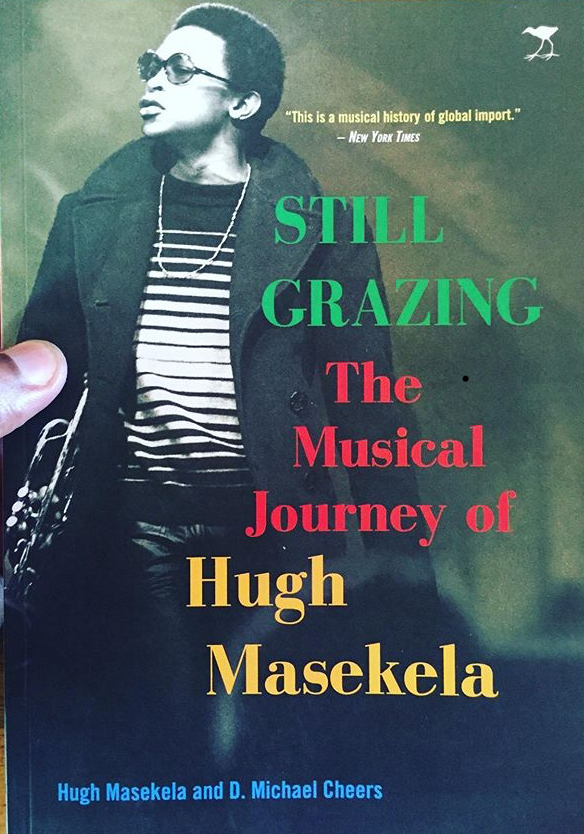
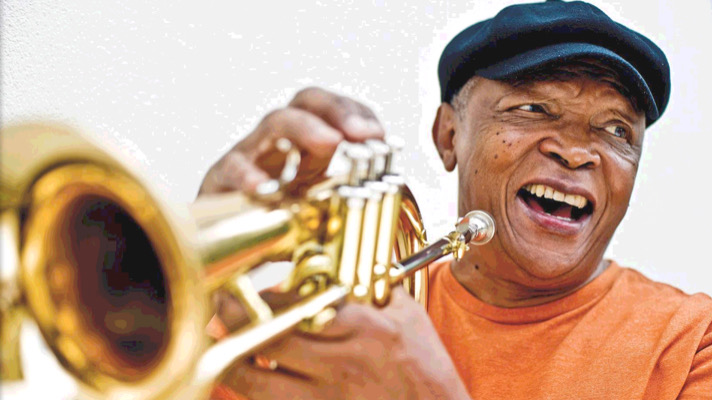
I choose to celebrate Hugh Masekela by continuing to listen to his music and his interviews. On both mediums he shared his views, experiences, and mostly importantly his elaborate wisdow and wit. I choose to celebrate Bra Hugh – a name that we all affectionately called him with and that remains part of our collective memory here in South Africa – through his work of art. One important work of art that he gifted us with – that many do not speak much about is his memoir titled: Still Grazing: The musical journey of Hugh Masekela that he beautifully co-written with Michael Cheers, an Associate Professor of Journalism at the School of Journalism and Mass Communications in the United States of America (USA).
I recently finished reading Bra Hugh’s book and I must say it was a heart-warming read. I got to learn the good, bad and the ugly of Bra Hugh’s life. This book made me appreciate him holistically as cliched that may sound to some.
Without a doubt, this book will teach you a thing or two about the power of believing in yourself, about taking that leap of faith and following your passion. Hughie was willing to leave his family to follow his passion, that of being a Jazz Artist, a trumpeter to be precise. Today, he remains one of the most celebrated jazz artists to hail from the foreshores of Southern Africa. The young man was born KwaGuqa, Witbank (eMalahleni) in Mpumalanga. One can get to learn more on his biography from the book itself. Here, I choose to celebrate Hughie quite differently please allow me to celebrating him in the following way:
Bra Hugh lived his life to the fullest and was brave enough to chronicle this down in his memoir. When reading the book, you will be exposed to the demons he faced in his life. He also chronicles his demise that was caused by his addiction, not only to drugs but to alcohol and sex. In fact, the book is so brutally honest such that it leaves you questioning yourself, if you would ever be able to triumph against the demons that Hughie was able to overcome in his life?
This is a book I would recommend to any potential artist(s) out there, and to readers themselves, for them to learn from one of the greatest artists of Azania about the dangers of drug addiction. Artists in general are at high risk of mismanaging their finances and being addicts because of the nature of the industry they are members of. Hence I believe, reading this book can shed some light into your life in one way or the other.
As Dr. Don Mattera points out in the foreword, Bra Hugh is an icon that we cannot afford to ignore. It would be malicious of us to do so if you ask me. I therefore choose to celebrate him in song and the written word.
As Dr. Don Mattera points out in the foreword, Bra Hugh is an icon that we cannot afford to ignore. It would be malicious of us to do so if you ask me. I therefore choose to celebrate him in song and the written word. One particular song that I think resonates very well with his book is not just Still Grazing but The boy’s doin’it. He really did it – the whole world is fond of his music and his legacy at large.
In this version of the song, you cannot help but trace the influence that Fela Kuti had in this sound of music that he was grappling with at the time. In the book too, he speaks about the beauty of meeting Fela Kuti whom he endeared, dearly. I really enjoyed reading that part because during that time, Bra Hugh was searching for home. This moment in his life led to the birth of one of his greatest albums in my view called: Home is where music is. At the time, Hughie underwent a pilgrimage by traveling to Africa as he could not travel back to the country, at some point he was denied the opportunity to bury some of his loved ones just like most exiles that were prohibited from entering South Africa at the time. It was then that Hughie met Fela Kuti and him meeting Fela formed part of the ‘completion’ of his journey and pilgrimage. But, Bra Hugh admits in some interviews that he struggled for years, more 30 years, to perfect the Afrobeat / highlife sound that he wanted to infuse in his music, of course having been inspired by Fela Kuti himself and undoubtably his music.
Now, when listening to Bra Hugh’s latest collaboration that he did with Tony Allen – a project that they did a few years ago but only released this year, posthumously Bra Hugh’s lifetime, becomes a full-circle moment in terms of him perfecting the Afrobeat sound. Moreover, listening to this project called Rejoice is an act of celebrating Bra Hugh and Tony Allen who has recently passed on. I am sure wherever they are they are probably rejoicing. It is therefore worth reading this article below:
In closing, I choose to celebrate Bra Hugh by cherishing his values of cultural restoration and heritage preservation. In doing so, let us continue to celebrate Ntate Ramapolo Hugh Masekela, the son of Polina Bowers and Thomas Selema Masekela. A grandson of Johanna Mthise Mabena-Bowers and Mamoshaba and Hopane Masekela.
Ka nnete go iketsi ke go phela. (Indeed knowing thyself is to live). Dilo makwati, di tsewa mo go ba bangwe*. Inyathi ibuzwa kwabaphambili* – we learn from those who have walked the path before us.
(**NB: these are not direct translations and the two phrases meaning one of the same thing)
As Chimamanda Ngozi Adichie’s second novel, this book is by far a masterpiece by the Nigerian author. It tells a love story of a couple that found itself in rather unfavourable circumstances when a coup d’état unfolds to give birth to civil war in Nigeria, what is sometimes referred to as the Biafran war.
The story is told from the perspectives of Ugwu, the helper, Olanna one of the twins and Richard the white man that lived in Biafra in the 60s. This story is so complex such that you find it hard to reconcile with certain events that unfold in the story, I will come back to this point. The various themes explored in this novel range from: war, loss, memory, nationalism, tribalism and rape.
The latter is among the themes that forced me to be very much unsettled with this novel. Rape as a theme in this book is one of the things that I struggle to reconcile with in this magnum opus.
“There are some things that are so unforgivable that they make other things easily forgivable.”
For example, throughout the novel Ugwu is represented as this ‘helpless’, humble and uneducated helper who tries so hard to impress his employers: Odenigbo (who he referred to as Master) and Olanna – to a point where he learns to speak English and abandons his Igbo language. Now during this period in the novel, Ugwu is such an admirable character, you just cannot help but empathise with the young lad.
However, as the story progresses, he gets conscripted into the army of Biafra to fight against the Nigerian army where his given a nickname ‘Target Destroyer’. He all of a sudden becomes a violent beast who participates in murdering the vandals in one of the operations. In another operation, he gets influenced to participate in a gang rape. It is at this juncture that I struggle to reconcile with Ugwu’s character, a boy who at this point is educated given that he had enrolled at a school located at the university that his Master, Odenigbo was lecturing at – this despicable act is the last thing you would expect him to do. But he was determined enough to let his peers in the army influence him to become a rapist. It is really hard to reconcile with this fact. At what point do we continue loving him after doing what he did?
Another event is that of the main couple: Olanna and Odenigbo. Odenigbo was Olanna’s ‘revolutionary lover’ but unfortunately he later became a shadow of his former self, a very useless drunkard that lost his ambition. I struggled to reconcile with the idea that the Odenigbo the so-called “man of the people”, “the voice of reason” cheated on his wife. Not just once but on two occasions. Perhaps the first incident is forgivable but the second not so much – but I could be wrong. I stand to be corrected on this one. I also struggle to reconcile with Olanna’s double-standards. She hated her man for cheating on her but did the same sinful act with Kainene’s man, Richard. Mind you, Kainene was Olanna’s twin sister – who does such to their own blood? Is blood not supposed to be thicker than water – I guess this book depicts that at as a myth particularly at this juncture in the book.
I also struggled to reconcile with the ending of this novel, how could it end the way it did? I am so sad. Nonetheless, this book will definitely make you go through the most. I’ve read all Adichie’s novels from Purple hibiscus and Americanah but this one is definitely a masterpiece.
One thing Adichie knows how to do, and does best, is to write love stories. You just cannot take that away from her. Indeed, The world is silent when we died and this quote continues to resonate with these trying times of the COIV-19 pandemic. But how do we reconcile with that either? I will leave that to you.
I think in this novel Prof Mda offers us very nuanced ways of thinking about death.
This novel follows a story of Toloki, the Professional mourner who has moved out of the rural village because of circumstances that were beyond his control – disgruntlement with his father’s useless parenthood. He embarks on a journey to face the world on his own and become his own man. He later settles in a contemporary South African city where he meets his homegirl, Noria, and begins to revisit some of the memories of his ugly yet somewhat pleasant childhood. His companionship with Noria proves to be nothing but genuine love. Not romantic love but humane love which helps each of them to find completeness from the presence of the other in their respective lives.
However, during that period they become entangled with the unfortunate harsh realities of their neighbourhood and livelihood. An unfortunate reality that they are later able to make peace with.
Interestingly though, the idea of time is raptured in this book because the story does not necessarily follow a linear narrative as I have made it seem like it does. Instead, what the book does is to now-and-again explore on the idea of memory and reflection wherein characters revisit their pasts. A revisitation of the of an ugly and beautiful past that sometimes revisists my country too, South Africa, which so happens to be the country where the book is set. Having said that, the story unfolds within few days – from Christmas to New Year’s Eve. So the idea of time becomes very fascinating in this regard.
I must say, I thoroughly enjoyed the way the book sticked to its title by unpacking various ways of dying. A poignant statement in the book for me has to be “Death lives with us everyday. Indeed our ways of dying are our ways of living. Or should I say our ways of living are our ways of dying?”. A statement that really interrogates the notions of death in a very intriguing and nuanced manner.
The magical realism explored in this book gives the book a level of authenticity because mythology does not only exist in Greece it is also found in Africa. For example, in the book Toloki’s father, Jwara, is only able to be in his creative zone to make his beautiful figurines when Noria sings for him. Whenever she was not around him, he became sullen and could not be creative. The magic was in Noria’s angelic voice.
Another way in which magic realism is explored in the book is when Nefolovhodwe, a very complex character, gets visited by Jwara in his dream – instructing him to deliver the figurines to Toloki, who had long abandoned his home village. At this juncture, the book explores the idea of the dead not dying but continuing being in our midst. This in my view is particularly enthralling as it shows that that the “dead do not die” as Lebo Mashile poignantly points out in this poem.
Lebo Mashile is a master of the spoken word.
I cannot help but to read the two texts as one is so far as death is concerned. Secondary to that is the idea of namelessness is explored by both texts as the poem interrogates rigorously the idea that South Africa does not have a name just in the same way that the novel is set in an unknown or rather nameless city.
Indeed, “there are many ways of dying”. COVID-19 happens to be one them. With these short words, I definitely recommend this book.




 Koleka Putuma. Photo: Andy Mkosi